Amazon's 75-Character Title Limit: Restructure Your Listings Before AI Does It for You
What changes on July 27, and what happens if you wait
Amazon started rolling out a 75-character title limit in mid-June 2026, with enforcement beginning July 27. The old 200-character ceiling was always loosely policed, which is why keyword-stuffed titles became the default across most categories. That era is ending.
The consequence for ignoring it is not a warning email. According to seller-tool reports from ZonGuru and Trellis, Amazon rewrites over-limit titles with AI, then gives brands roughly a 14-day window to review or appeal the rewrite. An algorithm deciding how your hero ASIN is named, with your input limited to an appeal, is a bad trade for any FBA or DTC brand.
There is a carrot alongside the stick. Amazon is introducing an Item Highlights field with a 125-character cap, and multiple seller tools report it typically unlocks only after a listing’s title complies with the 75-character rule. Amazon’s own documentation is still sparse, but the sequencing seems consistent: fix the title first, then the new field appears.
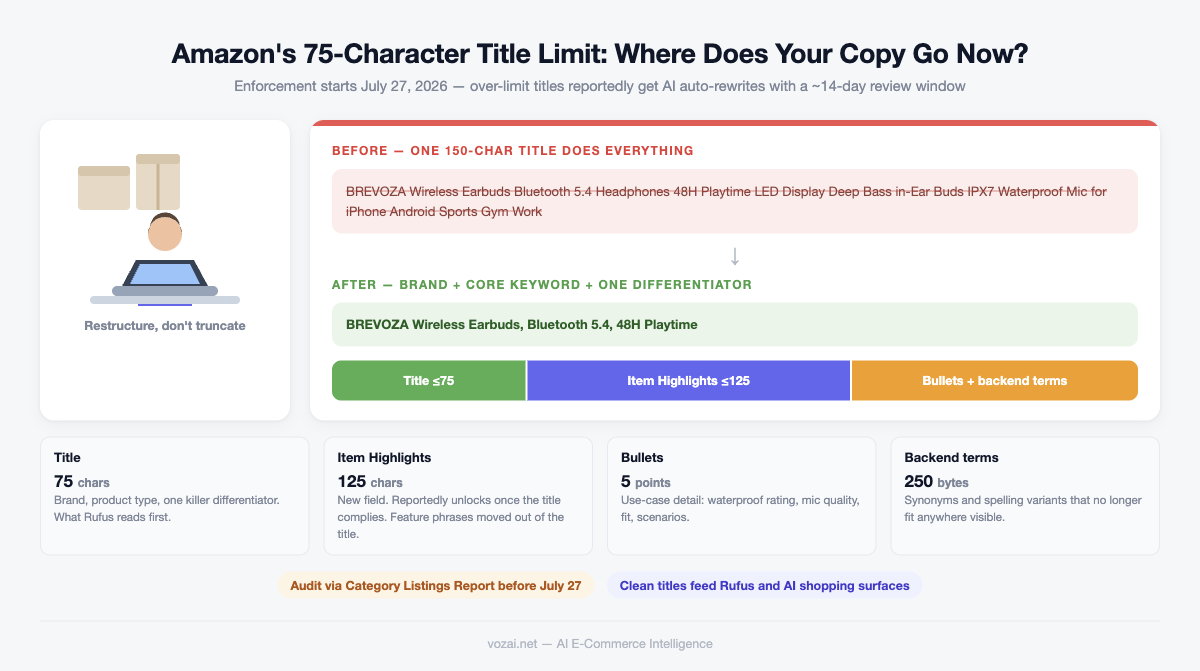
The formula: brand, core keyword, one differentiator
Seventy-five characters, spaces included, fits exactly three things: your brand name, your highest-converting keyword phrase, and a single differentiator. Everything else moves elsewhere.
Before (about 150 characters): Nordika Garlic Press Stainless Steel Professional Garlic Mincer Crusher Heavy Duty Rust Proof Easy to Clean Dishwasher Safe Kitchen Gadget for Home Cooking
After (53 characters): Nordika Stainless Steel Garlic Press, Dishwasher Safe
Pick the core keyword from your Search Query Performance data, not from instinct. The phrase with the best purchase share wins the title slot; the runners-up get redistributed across the other fields.
The differentiator should be the one attribute buyers actually filter on. For a DTC kitchen brand that might be the material or the dishwasher-safe claim, not a vague “professional grade.” One differentiator per title. Cramming in two usually reads worse than either alone.
Where every displaced keyword should land
| Field | Limit | What belongs there | Example |
|---|---|---|---|
| Title | 75 chars | Brand + core keyword + one differentiator | Nordika Stainless Steel Garlic Press, Dishwasher Safe |
| Item Highlights | 125 chars | Two or three secondary selling points, phrase style | Rust-proof zinc alloy, easy-clean design |
| Bullet points | ~200 chars each | Expanded benefits, use cases, guarantees | Cleaning steps, durability details, warranty |
| Backend search terms | 250 bytes | Spelling variants, synonyms, Spanish terms | garlic mincer, prensa de ajo |
Write Item Highlights as compressed phrases, not sentences. Avoid repeating title words: Amazon parses title, Highlights, and bullets as one semantic block, so duplication wastes characters that could carry new attributes.
Backend search terms matter more after this change. Long-tail modifiers that used to hide in bloated titles now need a home, and the 250-byte backend field is the natural landing spot for anything that does not deserve customer-facing space.
A five-step compliance audit in Seller Central
Step 1: Export every title. Pull a Category Listings Report, add a LEN column in your spreadsheet, and flag everything over 75 characters.
Step 2: Sort by traffic. Rank flagged ASINs by Sessions from your Business Reports and fix the top 20 percent first. Those are the listings where an unsupervised AI rewrite costs the most revenue.
Step 3: Rewrite with the formula and count characters including spaces. Leave a few characters of headroom rather than landing at exactly 75, since variation suffixes for color and size consume budget too.
Step 4: Watch for Item Highlights. The field reportedly appears once a title complies, so revisit the listing editor a few days after each fix and populate it with your secondary selling points.
Step 5: Monitor after July 27. If a stray title still gets an AI rewrite, reports point to roughly 14 days to review or appeal through Brand Registry. Set a weekly check on notifications so the window never lapses unnoticed.
Rufus is the reason this is happening
Amazon is rebuilding its catalog for AI shopping surfaces, and Rufus parses a clean semantic title far more reliably than a 180-character keyword wall. A title that states what the product is, plus a Highlights field that states why it is different, is exactly the structured input a recommendation model wants.
That structure travels beyond Amazon. ChatGPT and Perplexity increasingly surface Amazon products in shopping answers, and concise titles get quoted accurately where stuffed ones get mangled or skipped. Your title now has two audiences: the A9 ranking algorithm and a growing set of language models deciding whether to recommend you.
Sellers who restructure properly tend to come out ahead. A clean title reads better on mobile and gives AI surfaces data they can actually quote, while a competitor who stalls gets whatever wording Amazon’s rewrite model picks, plus a 14-day appeal window to argue about it. Enforcement begins July 27. The audit above is the work standing between you and that date.
Related Articles
Cloudflare Changed Its Defaults on September 15: The AI Agents Shopping for Your Customers May Be Locked Out
In July, Cloudflare split its single AI-bot switch into three separately managed categories: Search, Agent, and Training. From September 15, domains newly onboarding get a default that blocks Training and Agent bots on pages that display ads while Search stays allowed. Here is what each category covers, who the new default actually touches, and the dashboard audit that takes half an hour.
Google Shut Down the Content API: Migrate to Merchant API or Your Feed Starts Erroring in September
Content API for Shopping was sunset on August 18, 2026, and requests began experiencing progressive errors on September 1. Merchant API takes over product uploads, inventory, account management, and the Google Ads inventory link. Here is how to confirm in half an hour which API your stack calls, what goes dark when the feed stops, and how the extension request form works as an emergency lever.
Helium 10 vs Jungle Scout 2026: Which Amazon Seller Tool Is Worth the Money
Helium 10 and Jungle Scout are the two most popular Amazon seller research tools. This comparison covers keyword research, competitor analysis, listing optimization, and pricing across both platforms to help you pick the right one.