Helium 10 vs Jungle Scout 2026: Which Amazon Seller Tool Is Worth the Money
They Solve Different Problems
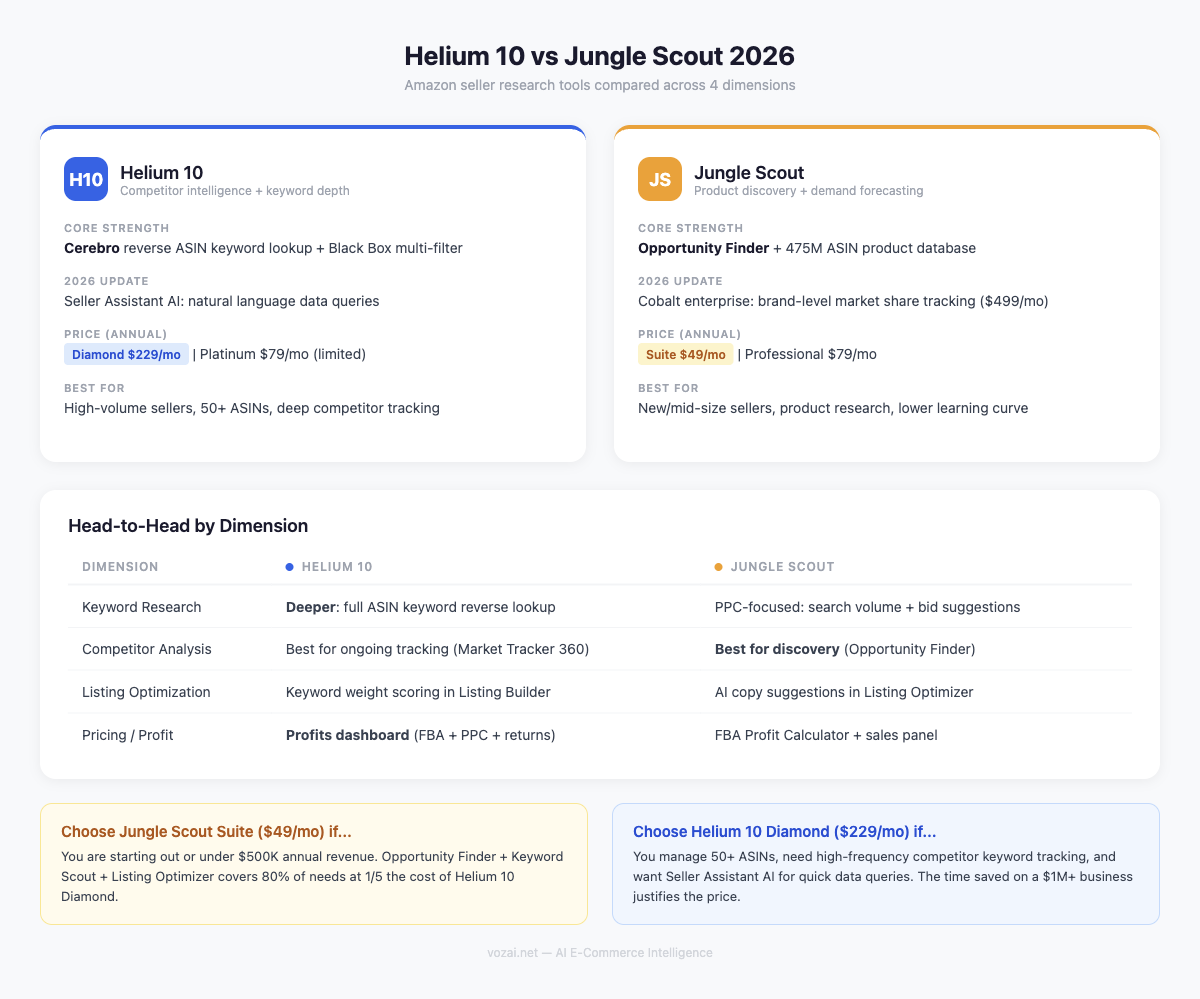
Both tools cover product research, keyword analysis, and listing optimization, but their origins shape their strengths. Jungle Scout started as a product database and demand estimator — its core value is helping you find products worth selling. Helium 10 started with reverse ASIN keyword lookup — its core value is showing you exactly what your competitors are doing and how they rank.
Jungle Scout’s Opportunity Finder filters product opportunities by monthly revenue, competition level, and profit margin down to the subcategory level. Its product database covers over 475 million ASINs with historical sales trends and seasonal demand patterns. In 2026, Jungle Scout launched Cobalt, an enterprise-grade product starting at $499/month that adds brand-level market share tracking, competitor brand matrix analysis, and new product launch monitoring. Cobalt is designed for brands and sellers doing over a million dollars in annual revenue.
Helium 10’s Cerebro and Black Box lean toward competitive intelligence. Cerebro reverse-engineers any ASIN to pull every keyword it ranks for, with search volume, organic position, and sponsored placement data. Black Box cross-filters product opportunities by keyword, category, and revenue range. The biggest 2026 addition is Seller Assistant AI, released in Q2. You can ask questions in plain language — “what keywords did this competitor gain ranking on last month” or “what is the average return rate in this category” — and the system pulls data from Cerebro, Xray, Profits, and other modules to answer without you switching between tools.
Head-to-Head Comparison
| Dimension | Helium 10 | Jungle Scout |
|---|---|---|
| Keyword research | Cerebro (reverse ASIN lookup) + Magnet (keyword expansion) + Seller Assistant AI | Keyword Scout (search volume + PPC bid data) + Opportunity Finder keyword filters |
| Competitor analysis | Black Box (multi-filter search) + Xray (Chrome extension) + Market Tracker 360 | Opportunity Finder + Product Tracker (sales monitoring) + Cobalt (enterprise brand matrix) |
| Listing optimization | Listing Builder (keyword weight scoring) + Audience (split-test surveys) | Listing Optimizer (AI copy suggestions + keyword coverage check) |
| Pricing and profits | Profits dashboard (real-time P&L including FBA fees, PPC spend, returns) | FBA Profit Calculator + Sales Analytics panel |
On keyword research, Helium 10 wins on depth. Cerebro pulls every keyword an ASIN ranks for with position data, making competitor keyword gap analysis straightforward. Jungle Scout’s Keyword Scout is more direct for PPC planning — it gives you search volume and suggested bid in a format you can plug into campaign setup.
For competitor analysis, Jungle Scout’s Opportunity Finder is better in the product selection phase, giving you a quick read on a niche’s competitive density and profit potential. Helium 10’s Black Box plus Xray combination is stronger once you have picked a category and need to dig into specific competitor strategies. Market Tracker 360 tracks your market share over time on a weekly basis, which matters when you are defending a position rather than entering a new one.
Listing optimization is close to a draw. Helium 10’s Listing Builder scores your title, bullet points, and description against keyword weight targets. Jungle Scout’s Listing Optimizer added AI-generated copy suggestions in recent updates — you feed it product details and target keywords, and it drafts a listing version, which is useful for sellers who find English copywriting difficult.
Pricing and What You Actually Get
The price gap between these two tools is significant, and it reflects different product philosophies.
Jungle Scout Suite costs $49/month (annual billing) and includes product research, keyword tools, listing optimization, and sales analytics. Professional is $79/month and adds historical product tracking and expanded AI features. Cobalt starts at $499/month for enterprise-level brand and category data.
Helium 10 Diamond costs $229/month (annual billing) and includes the full tool suite with generous usage limits. Platinum at $79/month caps your access to core tools — Cerebro gets 2,000 reverse lookups per month and Black Box gets 5,000 searches, which runs out faster than you expect when doing serious competitor research. Helium 10 has a free tier, but Cerebro is limited to 2 lookups per month — enough to see how the interface works, not enough to make decisions.
If your needs are product research and basic keyword analysis, Jungle Scout Suite at $49/month covers roughly 80% of what you need at one-fifth the cost of Helium 10 Diamond. If you need high-frequency competitor keyword monitoring, market share tracking, and AI-assisted data queries across multiple modules, the $229/month Diamond plan is where the tools actually work without friction.
Who Should Pick Which
Sellers who are starting out, running fewer than 20 ASINs, or doing under $500K in annual revenue will get more value from Jungle Scout Suite. Opportunity Finder identifies product opportunities, Keyword Scout builds your keyword list, and Listing Optimizer helps you write the listing. At $49/month, it covers the product selection through launch workflow without a steep learning curve.
Sellers managing 50 or more ASINs, doing over $1 million in annual revenue, and actively monitoring competitor movements need Helium 10 Diamond. Cerebro’s reverse lookup depth, Market Tracker 360’s share-of-market tracking, and Seller Assistant AI’s quick data retrieval save hours of manual work each week when you are managing a large catalog. Diamond also supports multi-user sub-accounts, which matters for teams.
A combined approach is common. Many sellers use Jungle Scout Suite for product selection decisions and Helium 10 (free tier or Platinum) for keyword reverse lookups and listing optimization. The two tools pull from different data sources, so cross-referencing reduces the risk of committing to a product based on one dataset.
What Changed in 2026
Helium 10’s Seller Assistant AI is the most notable update this year. Instead of opening Cerebro, Xray, and Profits separately, you can ask questions in a single chat interface and the system routes your query to the relevant module. For straightforward lookups like “top 10 organic keywords for this ASIN last month,” it responds quickly and the data matches what you would see pulling the report manually. For more complex analysis like “how has competition in this category shifted compared to last year,” it sometimes needs a few follow-up prompts to deliver a precise answer, but it is still faster than navigating between tools.
Jungle Scout’s Cobalt serves a different audience entirely. If you are a brand owner, an agency, or a high-volume seller who needs category-level brand share distribution, competitor brand launch cadence, and advertising strategy shifts, Cobalt’s data dimensions are a tier above what Suite and Professional offer. The $499/month starting price signals that it is not built for small or mid-size sellers.
FAQ
What can you do with Helium 10's free plan?
Does Jungle Scout offer a free trial?
Can you use both tools at the same time?
How accurate is Helium 10's Seller Assistant AI?
Which tool is better for PPC campaign management?
What is the difference between Cobalt and Market Tracker 360?
Related Articles
AI Traffic Control Compared 2026: How Cloudflare, Akamai and Vercel Classify Bots Differently
Cloudflare split AI traffic into Search, Agent and Training in July 2026. Akamai sorts the same traffic into training crawlers, search crawlers and fetchers. Vercel's AI bots managed ruleset covers training, search and user-generated fetches. Three vendors, nearly identical splits, different names and different defaults. A selection guide with a comparison table, an honest read on robots.txt, and a recommended setup for three kinds of store.
AI Product Data Enrichment Tools Compared 2026: Salsify, Feedonomics, and Productsup
The three vendors sound like they do the same thing. They do not. Salsify governs product content, Feedonomics runs feeds for you as a managed service, and Productsup gives you an enterprise catalog pipeline you configure yourself. Includes an honest section on when you need none of them.
Amazon Seller Assistant in Claude: A Setup Guide for US Sellers
Amazon announced the Selling Partner plugin at Accelerate on September 23, 2026, bringing Seller Assistant into Amazon Quick and Claude. What it can read and change, the three always-on workflows to set up first, and the limits: no ads, one account at a time, US stores only.