Customer.io AI Agent vs Klaviyo Marketing Agent: Picking a Single-Prompt Campaign Builder
Two Single-Prompt Agents, Two Very Different Starting Points
Klaviyo’s marketing AI agents entered public beta on July 1, 2026, as reported by Digital Commerce 360; the beta pairs a Marketing Agent with a Customer Agent for service work. Customer.io got there earlier, rolling out its AI Agent since April, and according to the announcement, every paying account gets 100,000 intro AI credits to start.
The demo looks identical on both sides. Type one sentence, say a three-email winback for customers who have not ordered in 30 days, and the agent builds the full flow: branches, delays, copy, subject lines. The architecture underneath is where they split, and that split should drive your choice more than any feature list.
The Data Model Sets the Ceiling
A campaign agent is only as good as the data it can read. Prompt quality matters far less than what sits underneath it.
Klaviyo’s Marketing Agent inherits a purpose-built e-commerce data model. Connect Shopify and orders, abandoned carts, and browse events flow straight into profiles; the agent drafts against that structure and leans on Klaviyo’s mature flow library. It has effectively seen more winback flows than any single marketer ever will.
Customer.io treats everything as an event. It does not assume you sell physical products: trial starts, plan downgrades, and feature-usage counts all work as triggers, and the pipeline is developer-first, with APIs and webhooks as the primary interface. The trade-off is that you supply the raw material, and the agent’s output is only as clean as the events you send it.
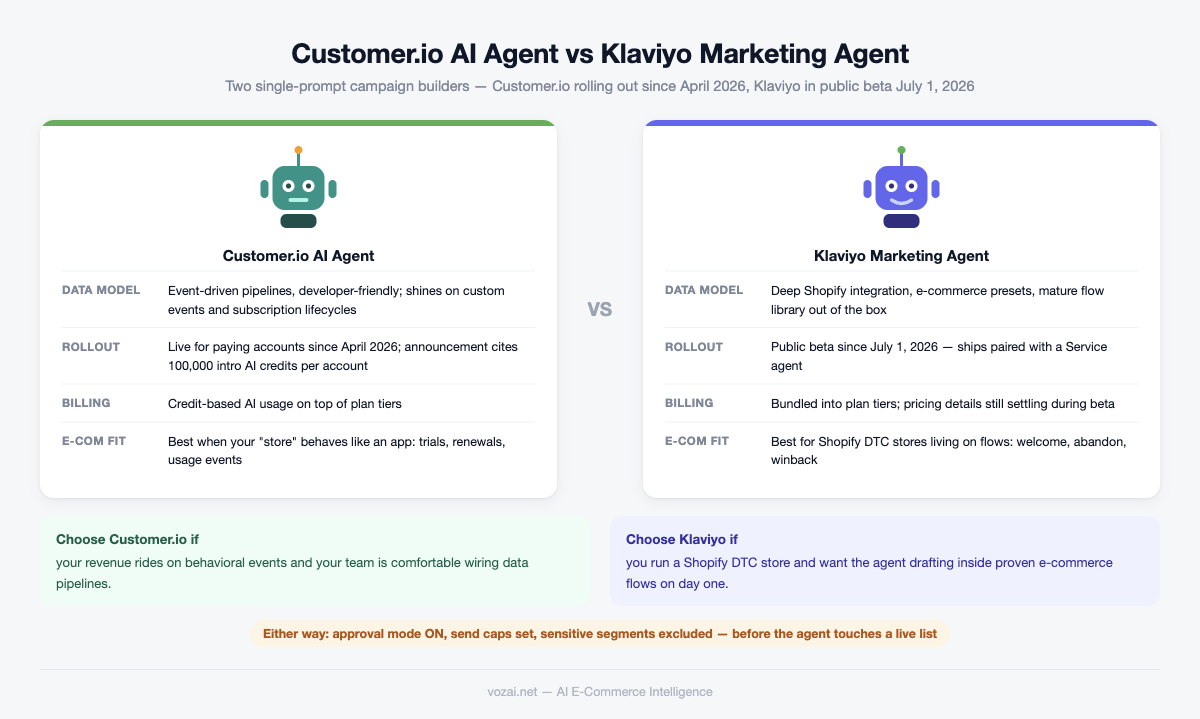
Head-to-Head
| Dimension | Customer.io AI Agent | Klaviyo Marketing Agent |
|---|---|---|
| Availability | Rolling out since April 2026 | Public beta since July 1, 2026 |
| Data model | Event-driven, custom schema | E-commerce preset, deep Shopify sync |
| Generation source | Your own events and history | Built-in flow template library |
| AI pricing | Credit-based; 100,000 intro credits per paid account | Bundled into plan tiers during beta |
| Best-fit store | Subscription, SaaS-like, app-driven | Shopify DTC, standard e-commerce |
| Developer experience | APIs and webhooks first | UI first |
Pricing deserves a closer look. Customer.io meters agent usage in credits, which caps your budget exposure but means watching consumption once the intro allowance runs out, and post-credit pricing is still settling. Klaviyo bundles the agent into existing plan tiers during beta, so costs stay predictable, though contact-based plan pricing still climbs as your list grows. Both are moving targets, so confirm current rates during your trial.
What to Test in a Two-Week Trial, and the Guardrails First
Run both platforms for two weeks on the same tasks rather than on each one’s home turf.
Week one, test generation: feed both the identical prompt, something like a three-touch nurture for first-time buyers over seven days, then judge the branch logic, how much copy needs rewriting, and whether the agent hallucinates products or events your store does not have. Week two, test revision: ask each agent to modify its own flow, swap email two for SMS, restrict a branch to high-AOV customers. One-shot generation is easy; iteration is the daily reality.
Before either agent sends anything, set the guardrails: keep approval mode on so a human reviews every generated campaign, cap send volume so one flow cannot hit your full list, exclude sensitive segments such as open refunds and recent complaints, and put brand-voice rules in the agent’s persistent configuration instead of repeating them in every prompt.
The Verdict
Choose Klaviyo Marketing Agent if you run a Shopify DTC store, your data is the standard order-cart-browse trio, and nobody on the team writes code. It works out of the box, and the template library backstops weak prompts. Existing Klaviyo stores have zero migration friction; just opt into the beta.
Choose Customer.io AI Agent if your business behaves like a subscription or SaaS product: memberships, courses, app purchases. Those events will not fit Klaviyo’s commerce schema cleanly, and Customer.io’s custom events plus a developer-maintained pipeline give the agent better raw material to work with.
Sources: Digital Commerce 360, July 1, 2026; the Customer.io announcement.
Related Articles
Shopping Agents That Take Payments: Sierra vs Fin vs Agentforce vs Decagon
Sierra connected to Stripe on October 20 so its AI agents can take card payments mid-call. Fin charges $0.99 per resolution, Agentforce bills per conversation or by credits, and Decagon quotes enterprise contracts only. The billing model fits a certain company size, and picking the wrong one costs more than any feature gap.
AI Traffic Control Compared 2026: How Cloudflare, Akamai and Vercel Classify Bots Differently
Cloudflare split AI traffic into Search, Agent and Training in July 2026. Akamai sorts the same traffic into training crawlers, search crawlers and fetchers. Vercel's AI bots managed ruleset covers training, search and user-generated fetches. Three vendors, nearly identical splits, different names and different defaults. A selection guide with a comparison table, an honest read on robots.txt, and a recommended setup for three kinds of store.
Salesforce Buys Braze for $5.66B: What It Changes for Email and CRM Stacks
Salesforce signed a definitive agreement to acquire Braze on October 20 for roughly $5.66 billion in enterprise value, paying $47.50 in cash per Class A share. Braze has about 2,770 customers and the deal is expected to close in Salesforce's fiscal 2028. If you run Klaviyo or Mailchimp, the contract term and integration timeline matter more than the headline.