TikTok Creator Picks vs Amazon Creator Connections vs Shopify Collabs: AI Creator Matching in 2026
How Each Platform Matches Creators to Products
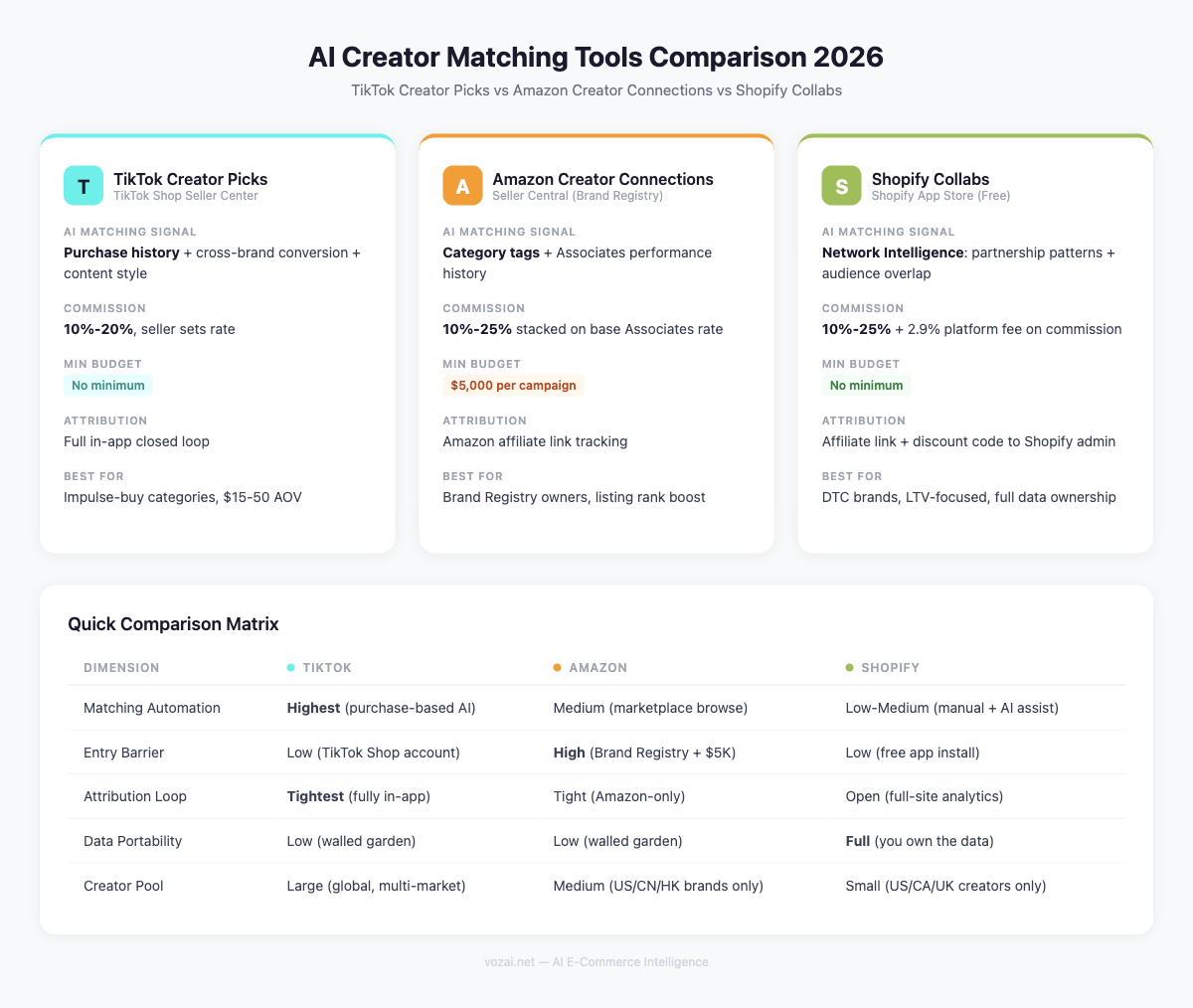
TikTok Creator Picks, built into TikTok Shop Seller Center, draws on the deepest behavioral dataset of the three. Its recommendation engine weighs audience purchase history, cross-brand conversion rates, content style affinity, and category performance rather than relying on follower demographics alone. With TikTok Shop’s global GMV projected at roughly $66 billion for 2026, the sheer volume of transaction data feeding these signals gives it a structural edge in matching accuracy for impulse-buy categories.
Amazon Creator Connections takes a marketplace approach. Brands post campaign briefs inside Seller Central specifying products, timing, and budget. Creators browse available campaigns, opt in, and promote via affiliate links. Amazon’s matching leans more on category tags and the creator’s historical Associates performance than on automated recommendation. The matching is less automated, but traffic lands directly on an Amazon product listing where the buyer is already primed to convert.
Shopify Collabs introduced Shopify Network Intelligence in late 2025, analyzing aggregated data across Shopify stores to recommend creators based on successful partnership patterns and audience overlap. Because Shopify merchants span an enormous range of categories and sizes, the recommendation quality tends to be less precise than TikTok’s or Amazon’s. Collabs works best when the merchant already has a clear brand identity and is willing to manually curate their creator roster.
Commission Structures Compared
The commission model determines how much you pay, who controls the rate, and what platform fees sit on top. Here is how the three stack up.
| Dimension | TikTok Creator Picks | Amazon Creator Connections | Shopify Collabs |
|---|---|---|---|
| Who sets the rate | Seller, with platform-suggested ranges | Seller, 10% minimum required | Seller, no platform minimum |
| Platform fee | TikTok takes a percentage of GMV | No additional fee beyond standard referral fees | 2.9% fee on commission payouts |
| Minimum budget | No hard floor | Typically $5,000 per campaign | None |
| Typical commission range | 10%-20% | 10%-25% (stacked on top of base Associates rate) | 10%-25% (common DTC range) |
Pay attention to Amazon’s stacking mechanic. Creators already earn a base Associates commission of roughly 1%-4% depending on category. The brand’s Creator Connections offer adds on top of that, so a 15% campaign offer could mean the creator earns 18%-19% total. This makes higher offers disproportionately attractive compared to generic affiliate earnings and directly influences which creators choose your campaign over a competitor’s.
Shopify’s 2.9% fee is charged on the commission amount, not on total order value. For a 15% commission rate, the effective platform cost is only about 0.4% of GMV, which keeps the overall expense low.
Eligibility and Seller Requirements
TikTok Creator Picks is accessible to any seller with an active TikTok Shop account. The platform operates in the US, UK, and several Southeast Asian markets, and there is no separate enrollment beyond setting up TikTok Shop itself. This makes it the lowest-barrier option of the three.
Amazon Creator Connections requires Brand Registry enrollment, which in turn requires a registered trademark. Seller accounts must be based in the US, China, or Hong Kong. Agencies and resellers without Brand Registry access are excluded. The $5,000 minimum campaign budget further filters out sellers who are still testing the waters. This is a tool designed for established brands, not for new private-label experiments.
Shopify Collabs is a free app available to any Shopify merchant through the app store. On the creator side, however, participation is currently limited to creators based in the US, Canada, and the UK. If your target market falls outside these three countries, the available creator pool will be noticeably thinner.
Attribution and Data Transparency
Attribution quality varies across the three platforms, and the gaps affect how reliably you can measure creator ROI.
TikTok runs the tightest closed loop. The entire journey from video view to cart to checkout happens inside TikTok. Sellers get per-creator breakdowns of impressions, clicks, add-to-carts, and conversions with a clear attribution window. The tradeoff is data portability: TikTok’s analytics stay inside TikTok, making it difficult to merge with your DTC or Amazon reporting stack.
Amazon’s attribution is similarly self-contained. The platform automatically tracks all purchases driven by a creator’s affiliate link, including items the buyer adds during the same session. Campaign reports show clicks, conversion rates, and revenue. Brands do not need their own tracking infrastructure, but they also do not get visibility into off-Amazon user behavior.
Shopify Collabs relies on affiliate links and discount codes for attribution, with all data flowing into the merchant’s own Shopify admin. The advantage is native integration with your full store analytics, meaning you can track a creator-referred customer through repeat purchases and lifetime value. The disadvantage is that any organic traffic a creator generates, such as a viewer searching your brand name directly instead of clicking the link, goes unattributed.
Which Platform Fits Which Seller
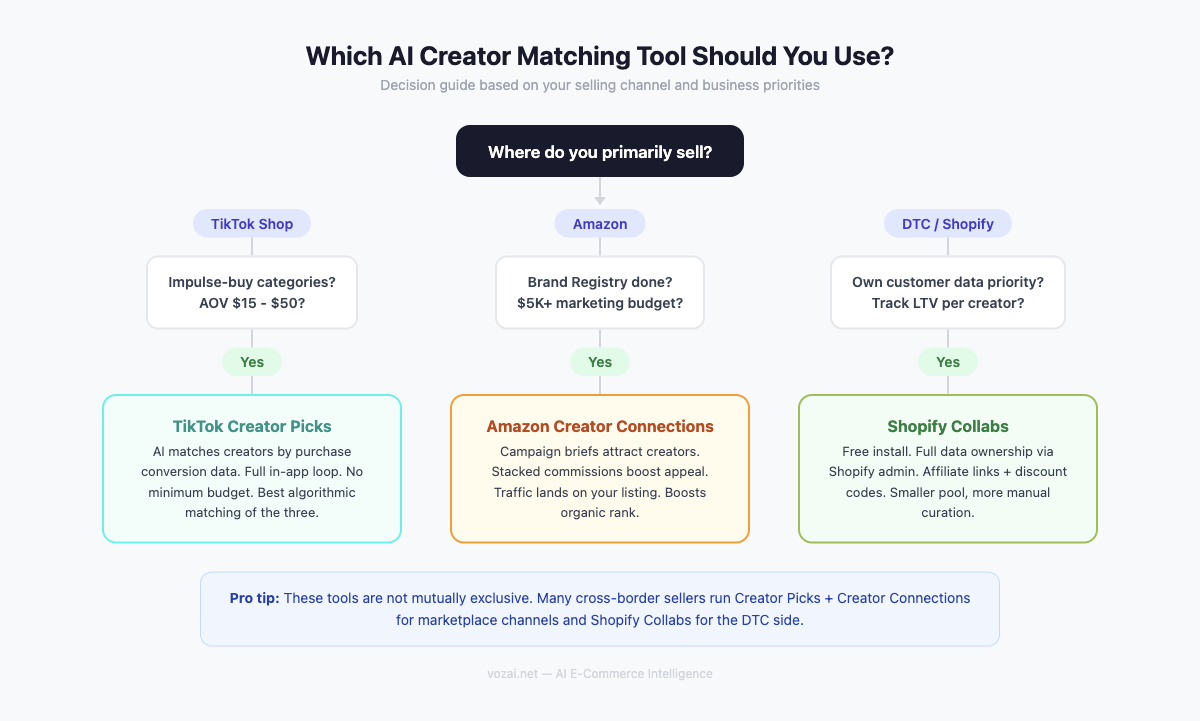
The right choice depends on where you sell and what you optimize for.
For TikTok-native sellers in impulse-buy categories like beauty, gadgets, or snacks with average order values between $15 and $50, Creator Picks is the strongest option. Its algorithmic matching surfaces mid-tier creators with proven conversion track records, and the in-app purchase loop minimizes drop-off between discovery and checkout.
For Amazon brand owners who have completed Brand Registry and want creator content to boost listing rank and conversion rate, Creator Connections is purpose-built. The $5,000 minimum budget means it suits brands with dedicated marketing spend rather than sellers in experimentation mode.
For DTC merchants on Shopify who prioritize owning customer data and building long-term creator relationships, Collabs offers the most natural fit. Zero upfront cost, full data ownership, and direct integration with your store analytics make it appealing for brands focused on repeat purchases and customer lifetime value. The limitation is a smaller creator pool and less automated matching, which means more manual outreach early on.
These tools are not mutually exclusive. Many cross-border sellers run Creator Picks and Creator Connections in parallel for their marketplace channels while using Shopify Collabs to manage the DTC side. Set commission strategies and ROI benchmarks per channel rather than applying a single framework across all three.
Related Articles
AI Traffic Control Compared 2026: How Cloudflare, Akamai and Vercel Classify Bots Differently
Cloudflare split AI traffic into Search, Agent and Training in July 2026. Akamai sorts the same traffic into training crawlers, search crawlers and fetchers. Vercel's AI bots managed ruleset covers training, search and user-generated fetches. Three vendors, nearly identical splits, different names and different defaults. A selection guide with a comparison table, an honest read on robots.txt, and a recommended setup for three kinds of store.
AI Product Data Enrichment Tools Compared 2026: Salsify, Feedonomics, and Productsup
The three vendors sound like they do the same thing. They do not. Salsify governs product content, Feedonomics runs feeds for you as a managed service, and Productsup gives you an enterprise catalog pipeline you configure yourself. Includes an honest section on when you need none of them.
Shopify x Trustpilot Verified Reviews: Building Trust Signals That AI Search Actually Uses
Trustpilot and Shopify launched a direct integration on June 29, 2026, letting merchants embed verified reviews in their storefronts and manage feedback from the Shopify dashboard. This article breaks down what the partnership means for AI search visibility and how to combine it with your existing review stack.