Perplexity Buy with Pro Economics: Does the AI Channel Actually Make Money
The five Perplexity pieces already on this site walk you through getting listed and getting recommended. This one assumes you are already in, or deciding whether to bother, and asks the only question that survives contact with a P&L: after Perplexity takes its cut, does a Buy with Pro sale actually make you money, or are you just renting a checkout and handing over the margin.
That matters because the channel is no longer a rounding error. Perplexity’s Buy Now agent reportedly reached around 2 million monthly active shoppers, with the shopping layer running at roughly a $2 billion annualized GMV rate as of July 2026. Real volume means the take rate is real money, not a demo-day line item. So the decision is worth doing with actual numbers rather than vibes.
The take rate is the whole story
Perplexity reportedly charges 8 to 12% of GMV on a completed Buy with Pro transaction, category-dependent, and that sits on top of payment processing. Stripe’s standard published US rate is roughly 2.9% plus 30 cents, and it applies here the same way it would on your own checkout. So the marginal cost of the channel, versus selling the identical item on your own Shopify store, is essentially the commission: call it 8 to 12 points of the sale price that you would otherwise have kept.
There is one credit on the other side of the ledger, and it is easy to miss. Free shipping is included on every Buy with Pro order, and Perplexity funds it, not you. If you already eat shipping on your own store to offer free delivery, that is a cost you do not carry on these orders. On a low-ticket item where a $6 parcel is a big slice of the order, that subsidy can claw back most of the commission. On a $120 order it barely moves the needle. Keep the offset in mind, but do not let it distract from the headline: the commission is the number that decides everything.
You also stay the merchant of record and keep 100% of the revenue minus that commission, so this is not a marketplace reselling your goods. It is your sale, at your price, with a toll on the way out. The formal Merchant Program has no application fee, no subscription, and no minimum, so the only real cost is the per-transaction take. Which is exactly why the arithmetic below is the whole decision.
What the commission does to your margin
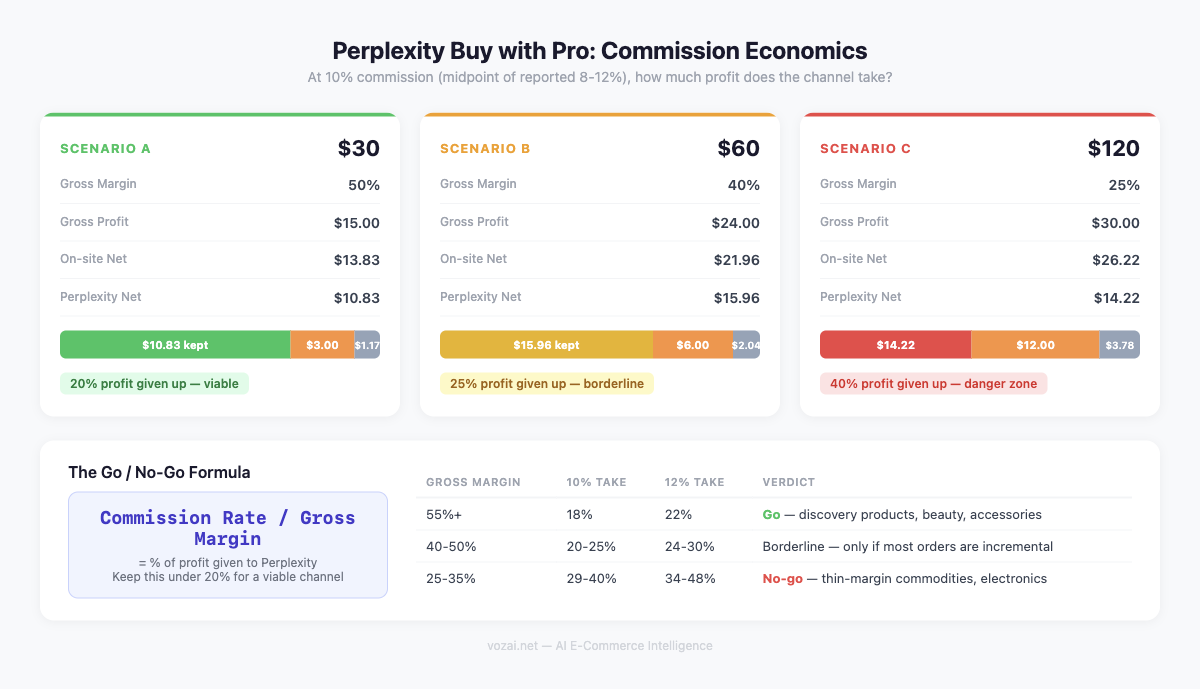
One ratio does most of the work here: the share of your gross profit you hand to Perplexity is roughly the commission rate divided by your gross margin. A 10% take on a 50% margin costs you 20% of your profit. The same 10% take on a 25% margin costs you 40%. Ignore the sale price for a second, because the ratio is what bites.
Now the worked numbers. Assume a 10% commission (the midpoint of the reported range), Stripe at 2.9% plus $0.30, and GMV equal to the item price since shipping is free. On-site net is gross profit minus the Stripe fee; the Perplexity net subtracts the commission as well.
| Scenario | AOV | Gross margin | Gross profit | Stripe fee | On-site net | Perplexity net | Profit given up |
|---|---|---|---|---|---|---|---|
| A | $30 | 50% | $15.00 | $1.17 | $13.83 | $10.83 | 20% |
| B | $60 | 40% | $24.00 | $2.04 | $21.96 | $15.96 | 25% |
| C | $120 | 25% | $30.00 | $3.78 | $26.22 | $14.22 | 40% |
Check any row. Scenario B earns $24.00 gross, pays Stripe $60 times 2.9% plus $0.30 = $2.04, and nets $21.96 on your own store. The $6.00 commission (10% of $60) drops the Perplexity net to $15.96, and $6.00 is 25% of the $24.00 gross profit. Scenario C is the ugly one: a $120 order at a 25% margin gives up $12.00 in commission, which is 40% of its gross profit, and at the top of the reported range, a 12% take, that becomes 48%. Almost half your profit gone on a single sale.
Now fold in the free-shipping credit. If you would otherwise fund a $6 parcel to ship this order yourself, subtract $6 from the on-site net, not the Perplexity net, because Perplexity pays it. In scenario A that closes the gap entirely and then some, so the Perplexity sale actually nets more than the shipping-inclusive on-site sale. In scenario C the $6 offset still leaves you $6 behind. The subsidy rescues cheap, shipping-heavy orders and does almost nothing for expensive, thin ones.
The go / no-go line
Put the formula to work as a threshold. If you want to give up no more than a fifth of your gross profit to the channel, a reasonable ceiling for what is really a discovery tax, then at a 10% take you need a gross margin of about 50% or better. Below that, the toll starts eating a share of profit most brands would not accept on a single channel. That is the anchor: rate divided by margin, held under whatever percentage of profit you are willing to rent out.
Which product profiles clear it. High-margin goods where the buyer is genuinely discovering you, such as beauty, supplements, accessories, or niche design pieces at 55% margin and up, clear it easily, because even a 12% take is a small slice of a fat margin and the buyer was never going to type your URL. Low-ticket items where free shipping would have cost you real money get a second boost from the subsidy. These are the sales worth having.
Which profiles do not. Thin-margin commodities are the trap: electronics accessories, generic household goods, anything at 25% margin or below where you already compete on price. At those margins the commission is a third to nearly half of your profit, and there is rarely enough discovery premium to justify it. High AOV makes it worse, not better, because the commission is a percentage. A big order just means a bigger dollar toll on the same thin margin. If you sell $120 commodities at 25%, this channel is close to working for the platform, not for you.
The number that actually decides it: incrementality
Everything above compares a Buy with Pro sale to the same sale on your own store. But that comparison only holds if the customer would have bought from you anyway. That is the real question hiding under the commission: is this a new buyer, or one you already had?
Split every Buy with Pro order into two kinds. An incremental order is a customer you would never have won: they asked Perplexity, it recommended you, and without the channel that sale did not exist. For those, the right comparison is not on-site net versus Perplexity net, it is Perplexity net versus zero. Scenario C’s ugly $14.22 is pure gain when the alternative was nothing. A cannibalized order is the opposite: someone who would have found your store through branded search or as a returning customer, but happened to check out inside Perplexity. There you did not gain a sale, you just paid commission on one you already owned, a straight loss of the gap, $6.00 in scenario B, on every one.
So the channel’s value depends on the mix. If a fraction of your Buy with Pro orders are truly incremental and the rest are cannibalized, the break-even is where the gains on the new buyers cover the commission wasted on the old ones. That break-even incremental fraction is just the commission gap divided by your on-site net: about 22% in scenario A, 27% in scenario B, and 46% in scenario C. Read scenario C plainly: nearly half of your Buy with Pro orders have to be customers you could not have reached any other way, or the channel is destroying margin rather than adding it.
That reframes the whole decision. A brand nobody searches for by name, selling high-margin discovery products, is close to the ideal case, because most orders are incremental and the take is a small share of a healthy margin. An established brand with strong branded search, selling thin-margin goods, is the worst case, because most Buy with Pro orders are people who would have bought anyway, and you are paying 8 to 12% for the privilege of moving your own checkout into someone else’s app. Same commission, opposite verdict. Measure your incremental share before you celebrate the volume.
Related Articles
SEO for a New Trilingual Site: What We Did in the First Month (and What We're Still Measuring)
A first-month SEO log for a small site in English, Simplified Chinese and Traditional Chinese. Google started showing it in search; Bing had read the sitemap and still hadn't crawled the homepage. What we set up on day one, what the early data showed, why Google shows a globe instead of our favicon, where the first links came from, and what we chose not to do.
Amazon Seller Assistant in Claude: A Setup Guide for US Sellers
Amazon announced the Selling Partner plugin at Accelerate on September 23, 2026, bringing Seller Assistant into Amazon Quick and Claude. What it can read and change, the three always-on workflows to set up first, and the limits: no ads, one account at a time, US stores only.
Prime Day 2026 Postmortem: AI Chatbot Referrals Converted 40% Better, So Fix Your Funnel Before Q4
Adobe pegged Prime Day 2026 at 26.4 billion dollars in US online spend, up 9.3% year over year. The bigger story: shoppers arriving from AI chatbots were 40% more likely to buy than search, email, or social visitors, the first time AI referrals topped the conversion table. AI-directed retail traffic rose 89% during the event. Here is the playbook to capture that channel before BFCM.