Etsy Is Live Inside ChatGPT, and Keyword-Stuffed Listings Are the First Casualty
On May 5, 2026, Etsy launched its app inside ChatGPT. A shopper can now describe what they want mid-conversation and get Etsy products recommended on the spot, which puts more than 100 million listings in front of roughly 700 million weekly ChatGPT users. Etsy’s own announcement on its news blog carried a telling headline: From keywords to conversation. That headline is the part sellers should sit with. The traffic opportunity is obvious; what’s less obvious is that this new surface does not rank listings the way classic Etsy search did. The title formulas many shops have refined for years, comma-separated keyword chains designed to catch every search variant, are actively unhelpful here. This article covers why, and what to change.
The ranking logic is different, and it’s not a tweak
When ChatGPT receives a shopping query, it routes the request to Etsy’s semantic relevance system. That system scores how well a listing matches the full meaning of what the buyer said: the occasion, the recipient, the style, the materials. The question it asks is whether your listing is a plausible answer to a described situation. Token overlap with whatever the buyer typed barely enters into it.
Classic Etsy search trained sellers to do the opposite. You researched what buyers typed into the search box, then packed titles and tags with every variant: singular, plural, synonyms, adjacent niches. That behavior was rational because the old ranking rewarded token overlap. A title like “Linen Dress, Summer Dress, Boho Dress, Maxi Dress” existed because it worked.
Semantic scoring doesn’t count repetitions. Five occurrences of “dress” tell the system less about your product than one clear phrase like “linen midi dress for beach wedding guests.”
Why stuffing now costs you instead of just not helping
Buyers talk to ChatGPT in full sentences: “I’m going to a beach wedding next month and need something breathable that photographs well.” The more specific the request, the more the retrieval system depends on your listing supplying matchable specifics. A title made of noun fragments answers none of the implied questions. What fabric weight? What occasion? Is it lined? Who is it for? Every blank is a match you can’t win.
There’s also a crowding-out effect. Title characters spent on the eighth synonym are characters not spent on “breathable,” “lined,” or “spring wedding guest,” the details conversational queries actually contain. Under classic search that trade made sense. Under semantic retrieval you are trading real signal for dead weight.
Retail Dive’s coverage of the launch noted the broader context: Etsy has been moving its own search toward semantic matching for a while, and the ChatGPT app pushes that direction to the front. Even sellers who don’t care about ChatGPT traffic are on this path whether they like it or not.
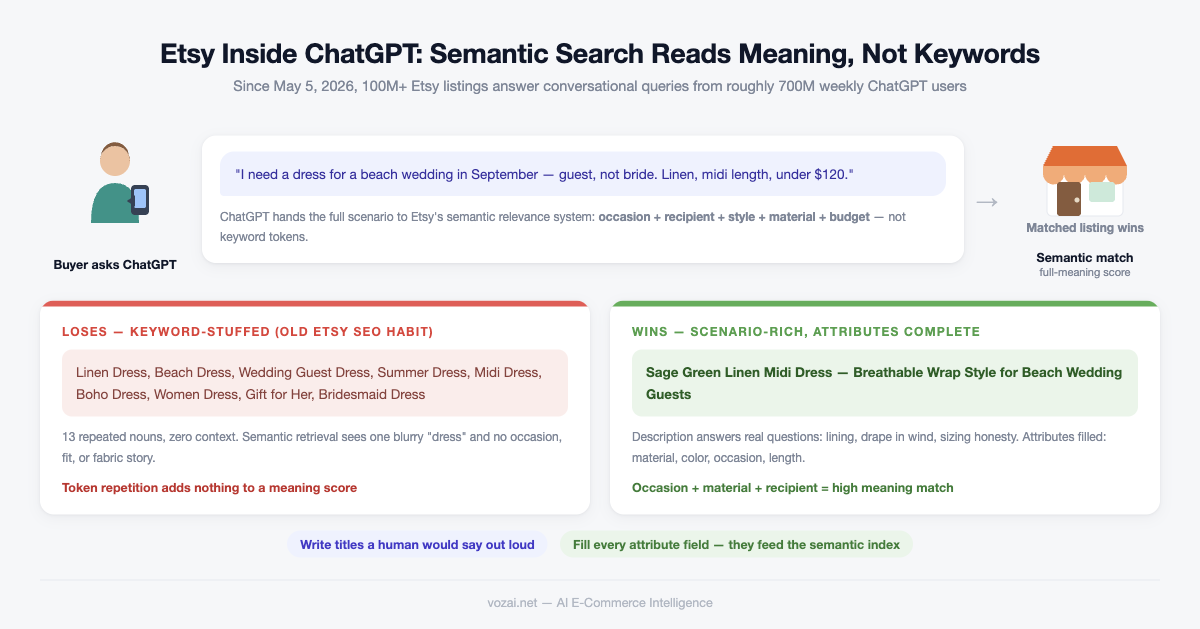
A listing rewrite, before and after
Here’s a typical stuffed title:
Linen Dress, Women Summer Dress, Boho Maxi Dress, Beach Dress, Wedding Guest Dress, Vintage Dress, Cottagecore Dress, Gift for Her
Under the old rules, this caught impressions from half a dozen query patterns. Read it as a semantic system would, though, and it’s nearly empty. Is the style boho, vintage, or cottagecore? What length, what weight, what season? Nothing in it answers a concrete buyer scenario. The rewrite:
Sage Green Linen Midi Dress for Beach Wedding Guests, Breathable Lined Summer Dress
First line of the description: Made from midweight 190gsm linen with a full lining, this midi dress is cut for outdoor weddings in warm weather. The square neckline and fitted waist photograph well, and it works as an everyday dress long after the wedding.
Every element of the buyer’s sentence, the occasion, the fabric concern, the photos, maps to something explicit in the listing. That correspondence is what the semantic system scores. It also happens to be better copy for humans: a buyer can decide in two lines whether this is their dress.
Old habits versus semantic-friendly practice
| Classic Etsy SEO habit | Semantic-search-friendly practice |
|---|---|
| Pack titles with comma-separated synonyms and variants | State one clear thing: material, product, who it’s for, what occasion |
| Open the description by restating title keywords | Open by answering the buyer’s most likely question |
| Fill attributes casually, skip the tedious ones | Complete every attribute: color, material, size, occasion |
| Use all 13 tags on near-duplicate phrasings | Spread tags across dimensions: occasion, style, recipient, technique |
| Bet on which exact terms buyers will type | Bet on which scenarios buyers will describe, and cover them |
The right-hand column has one common thread: every practice feeds the system concrete, scenario-matchable information. The attributes row deserves emphasis. Plenty of sellers agonize over titles while leaving structured fields half-empty, yet structured attributes are the easiest signal for a semantic system to consume. It’s the cheapest fix on this list.
Where to start this week
Don’t rewrite the whole shop. Take your ten best-selling listings, the ones most likely to surface in ChatGPT recommendations, and work through them in order: rewrite the title around occasion, recipient, and material; complete every attribute field; replace the first paragraph of the description with two plain sentences saying who this is for and why it fits their situation.
If you’re worried about tanking your existing search rank, keep the concern proportionate. Etsy itself is steering from keywords to conversation, and a listing that states its scenario clearly holds up on both surfaces. The listing that loses on both is the one that contains keywords but no information. Most of your competitors haven’t adjusted yet, and that window is the actual opportunity here.
Related Articles
SEO for a New Trilingual Site: What We Did in the First Month (and What We're Still Measuring)
A first-month SEO log for a small site in English, Simplified Chinese and Traditional Chinese. Google started showing it in search; Bing had read the sitemap and still hadn't crawled the homepage. What we set up on day one, what the early data showed, why Google shows a globe instead of our favicon, where the first links came from, and what we chose not to do.
Amazon Seller Assistant in Claude: A Setup Guide for US Sellers
Amazon announced the Selling Partner plugin at Accelerate on September 23, 2026, bringing Seller Assistant into Amazon Quick and Claude. What it can read and change, the three always-on workflows to set up first, and the limits: no ads, one account at a time, US stores only.